The reputation vs. the data
Both Honda and Toyota SUVs hold value better than the industry average. Consumer Reports, JD Power, iSeeCars, and Black Book residual-value data all consistently rank them in the top three of their respective segments. But there are real differences model by model, and Pennsylvania's used market has some regional quirks that national depreciation figures don't capture — winter demand, agricultural-truck culture in Lebanon and Berks County, and the pull of Philadelphia-metro trade-in wholesale pricing that reaches into Reading and Lancaster.
This isn't a "both are great, buy either one" article. The differences at each segment are worth understanding before you spend $25,000 on a used SUV that you'll drive for the next seven or eight years.
Compact SUVs: CR-V vs. RAV4
Both are perennial top sellers — the CR-V has been Honda's best-selling model globally for two decades, and the RAV4 has passed the Camry to become Toyota's best-seller in North America. Depreciation data over five years for recent model years (2019–2023):
- Toyota RAV4: approximately 35% depreciation from MSRP after 5 years.
- Honda CR-V: approximately 38% depreciation after 5 years.
- Toyota RAV4 Hybrid: approximately 30% depreciation — the class leader.
- Honda CR-V Hybrid: approximately 32% depreciation.
The RAV4 holds slightly more value, partly because Toyota's brand equity for reliability is marginally stronger in used-market perception. On the flip side, CR-V interior packaging is class-leading (40.4 inches of rear legroom versus 37.8 in a RAV4), which drives real-world buyer preference when families actually sit in both.
Winner in PA: too close to call. Both are excellent long-term holds. Winter buyers slightly favor the RAV4 AWD (it has a Multi-Terrain Select system on TRD Off-Road and Woodland trims that helps in unpacked snow). Families with cargo needs slightly favor the CR-V (larger and squarer cargo hold, easier-folding second row). The specific unit in front of you matters more than the badge.
Mid-size SUVs: Pilot vs. Highlander
- Toyota Highlander: approximately 42% depreciation after 5 years.
- Honda Pilot: approximately 44% depreciation after 5 years.
- Toyota Highlander Hybrid: approximately 33% depreciation — one of the best three-row hybrids for retained value.
Highlander wins on resale, again driven by Toyota's brand perception in the mainstream three-row segment. Pilot has better third-row access (easier one-touch lever, more head clearance), slightly more cargo (46.8 versus 16 cubic feet behind third row — wait, both are near 16, the difference is behind the second row: 84 versus 48 all seats folded in the Pilot's favor), and a genuinely capable AWD system in i-VTM4 that trumps the Highlander's standard AWD.
The Highlander Hybrid deserves special mention: 35+ real-world combined MPG, class-leading retained value, and a Toyota reliability record. If fuel matters and you're keeping the vehicle 6+ years, it's the smartest three-row used buy in central PA. See our RAV4 vs. Highlander comparison for a deeper look at Toyota's SUV lineup.
Subcompact and larger: HR-V vs. Corolla Cross, Passport vs. 4Runner
Subcompact: The HR-V is the more refined package inside but slower and less efficient than the Corolla Cross, which now comes in a hybrid variant that returns 42+ MPG combined. Corolla Cross Hybrid depreciation is running about 33% at 5 years — excellent.
Two-row mid-size: Passport vs. 4Runner is a mismatch. The 4Runner is legendary for holding value — some 5-year-old TRD Off-Road units retain 75%+ of original MSRP because supply is tight and demand from off-road enthusiasts is huge. Honda Passport is a genuinely competent vehicle (essentially a Pilot without the third row) but doesn't have anywhere near the same following or resale support. If you want a used 4Runner you're paying near-new money; if you want a used Passport you're getting a legitimate deal.
Full-size: Toyota Sequoia and Honda Pilot don't compete directly (Sequoia is a truck-based body-on-frame; Pilot is unibody). Sequoia holds value better but the Pilot is more comfortable and efficient as a daily driver.
What this means for used buyers in central PA
The Toyota resale premium is real, but it's smaller than most buyers think — and it disappears entirely if you keep the vehicle eight years or more, at which point both a Honda and a Toyota SUV have depreciated to essentially the same low percentage of original MSRP.
The resale premium on Toyota SUVs means you're often paying $1,000–$2,500 more for a comparable Toyota vs. Honda used. Whether that's worth it depends on your ownership horizon:
- Keep the vehicle 8+ years: both brands are still running strong. You paid more up front for no meaningful long-term benefit.
- Plan to trade in 3–4 years: the Toyota premium is smaller than it looks because you'll recoup more at trade-in. Wash.
- Plan to trade in 5–6 years: Toyota slightly wins on total cost of ownership.
- Plan to keep it forever: buy the best-condition example of either brand and don't overthink it.
PA-specific considerations: winter, salt, and rust
Both brands handle Central PA winters well with proper tires — a Blizzard-shod CR-V or RAV4 will outperform a stock 4Runner on all-seasons on Lebanon County snow every single time. The AWD system matters less than the rubber you have on it. That said:
- Toyota AWD systems on the RAV4, Highlander, and 4Runner range from adequate to excellent (4Runner best, RAV4 base worst).
- Honda AWD systems on the CR-V, Pilot, and Passport are excellent — i-VTM4 in the Pilot/Passport is arguably the best AWD system Honda has ever built.
Both have excellent parts availability at every independent shop between Lebanon and Harrisburg — anyone who works on Japanese imports knows Honda and Toyota inside and out. Nearest Honda dealers are in Lebanon (Faulkner) and Harrisburg; nearest Toyota dealers are in Palmyra and Harrisburg. Parts wait times are typically 24–48 hours max for anything non-exotic.
Rust protection is comparable. Both brands use standard galvanized steel in key underbody structures and both suffer eventually if you don't wash the undercarriage during winter. I've seen 12-year-old Toyotas with frame rot from farm use, and I've seen 15-year-old Hondas with pristine underbodies from garage-kept commuters. The vehicle's history matters far more than the badge.
The real tie-breaker: the specific vehicle in front of you
After twenty-plus years of dealing with used Honda and Toyota SUVs in Central PA, this is the single most important thing I can tell a buyer: the difference between a good Honda and a good Toyota is smaller than the difference between a well-maintained example and a neglected one within either brand.
A well-maintained CR-V EX-L with full service history is a better buy than a neglected RAV4 XLE with unknown history, every day of the week. A one-owner Pilot Elite that was garage-kept and dealer-serviced is a better buy than a three-owner Highlander Limited that was passed around lease returns.
Focus your evaluation on:
- Complete service history (or documented independent-shop equivalent).
- Clean CARFAX with no accidents.
- All recalls closed.
- Fluid change intervals adhered to.
- Underbody condition (frame, brake lines, subframe).
- Tire age and condition.
- Battery age.
Get those right and either brand serves you well for a decade.
Fuel, insurance, and total cost of ownership in PA
Beyond depreciation, a few smaller line items add up over a five-year ownership window:
- Fuel: Honda's 1.5-liter turbo (in CR-V) and 2.0-liter turbo hybrid (in newer CR-V Hybrid) both run on 87 unleaded. Toyota's 2.5-liter naturally aspirated four (RAV4) and 2.4-liter turbo (Highlander) also run on 87. No premium-fuel penalty on either brand's mainstream SUV lineup.
- Insurance: Both brands sit in the middle of insurance-cost brackets — cheaper than a comparable German rival, comparable to a Hyundai or Kia SUV. Lebanon County full-coverage insurance for a clean 40-year-old driver on a 2020 CR-V or RAV4 typically runs $1,100–$1,400/year.
- Maintenance: Both brands are affordable at independent shops throughout central PA. Honda Odyssey/Pilot timing belts on the V6 are a $900–$1,300 service around 100k miles; Toyota engines are timing-chain and require no equivalent service.
- Tires: Comparable — 235/60R18 for a CR-V EX-L, 225/60R18 for a RAV4 XLE, 235/55R20 for a Highlander XSE. Winter-tire budget is the meaningful line item, and it's identical between brands.
See what we have
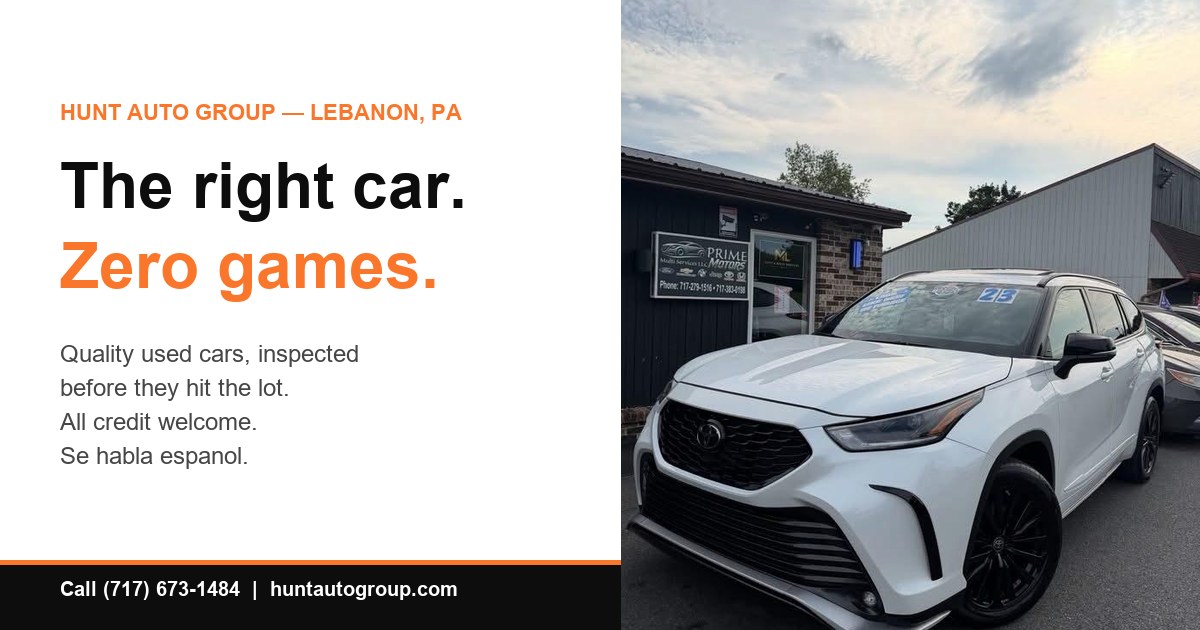
We regularly have both Honda and Toyota SUVs on our Lebanon lot. Read our full 2020 CR-V EX-L review, 2017 Pilot EX-L review, or 2023 Highlander XSE review for deeper looks at specific units. Browse current inventory, apply for financing, or call (717) 673-1484 for personalized recommendations. Serving Lebanon, Harrisburg, and central PA drivers.