Two SUVs, different families
The Toyota RAV4 and Highlander both wear the Toyota badge, share a network of dealers and independent specialists across central Pennsylvania, and both handle Central PA winters well with AWD. Beyond those similarities they're aimed at genuinely different buyers. Understanding who each is designed for makes the decision straightforward — and picking the wrong one means either paying for space you don't use or squeezing your family into a vehicle that's a size too small.
This comparison walks through size and seating, powertrains, fuel cost math, price and value, driving feel, reliability, winter capability, and finally who should buy which. All numbers are drawn from Toyota's official specs and real-world observation of Lebanon-area used sales in 2026.
Size and seating: the fundamental difference
RAV4: compact SUV. Seats 5. Rear seat is comfortable for adults on shorter trips (37.8 inches of legroom). Cargo behind the rear seat is 37.6 cubic feet — plenty for grocery runs and typical family loads. Overall length is 180.9 inches; wheelbase 105.9 inches. Weight around 3,500 pounds.
Highlander: mid-size SUV. Seats 7 (with second-row captain's chairs on XLE and above) or 8 (with second-row bench on LE). Third row is usable for kids and short adults, tight for anyone over 5'8" on longer trips. Cargo behind the third row is 16 cubic feet, behind the second row 48, all seats folded 84. Overall length is 194.9 inches; wheelbase 112.2 inches. Weight around 4,500 pounds.
The Highlander is 14 inches longer, 3 inches wider, and 1,000 pounds heavier. It swallows more people and more stuff. It also costs more to park in a Lebanon downtown lot, uses more fuel, and is measurably less nimble on a tight county road.
If your family is four people (two adults, two kids) or fewer, RAV4 is plenty. If you're regularly five or more, if you often carry your kids' friends home from soccer practice, if grandparents visit from out of town for a week and need a ride to Hershey Park, the Highlander earns its size.
Powertrains: what each engine actually is
RAV4 (2019+, XA50 generation):
- 2.5L Dynamic Force I-4 (A25A-FKS): 203 hp / 184 lb-ft. 8-speed automatic. Standard on LE, XLE, XLE Premium, Adventure, TRD Off-Road, Limited.
- Hybrid: 2.5L Atkinson four plus electric motors, 219 combined hp. eCVT. Standard on LE Hybrid, XLE Hybrid, XSE Hybrid, Limited Hybrid.
- Prime plug-in hybrid: 302 combined hp, 42-mile electric range, 94 MPGe.
Highlander (2020–2022 XU70, 2023+ XU70 refresh):
- 3.5L V6 (2GR-FKS, through 2022): 295 hp / 263 lb-ft. 8-speed automatic. Bulletproof.
- 2.4L Turbo I-4 (T24A-FTS, 2023+): 265 hp / 309 lb-ft. 8-speed automatic. See our full 2023 Highlander XSE review.
- Hybrid (2020+): 2.5L Atkinson four plus electric motors, 243 combined hp on 2020+ (245 on 2023+). eCVT.
Max towing: RAV4 rated at 1,500 pounds (3,500 on Adventure/TRD Off-Road with tow package); Highlander rated at 5,000 pounds properly equipped.
Real-world fuel economy in Central PA
EPA and real-world combined MPG in mixed central PA driving:
- RAV4 AWD (2.5L): EPA 27 combined; real-world 25–28.
- RAV4 Hybrid AWD: EPA 40 combined; real-world 37–42.
- Highlander AWD (2.4T, 2023+): EPA 24 combined; real-world 22–26.
- Highlander AWD (3.5L V6, 2020–2022): EPA 22 combined; real-world 19–23.
- Highlander Hybrid AWD: EPA 35 combined; real-world 32–37.
Fuel cost math at $3.35/gallon for 87 unleaded, 12,000 miles per year:
- RAV4 AWD 2.5L: about $1,540/year.
- RAV4 Hybrid AWD: about $1,050/year.
- Highlander AWD 2.4T: about $1,680/year.
- Highlander Hybrid AWD: about $1,180/year.
The RAV4 wins on gas efficiency in every powertrain configuration. RAV4 AWD saves about $140/year versus Highlander AWD. Hybrid versus hybrid saves about $130/year. Over five years those are $650–$700 differences — meaningful but not decisive.
Price and value on the central PA used market
Rough used-market pricing in central PA in 2026 for comparable trim/mileage:
- 2020 RAV4 XLE AWD, 60k miles: approximately $21,000–$23,500.
- 2020 RAV4 XLE Hybrid, 60k miles: approximately $24,500–$27,000.
- 2020 Highlander XLE AWD, 60k miles: approximately $27,000–$29,500.
- 2020 Highlander XLE Hybrid, 60k miles: approximately $30,000–$33,000.
- 2023 RAV4 XLE AWD, 25k miles: approximately $28,000–$31,000.
- 2023 Highlander XSE, 25k miles: approximately $34,000–$38,000.
The Highlander commands roughly a $5,000–$7,000 premium over a comparable RAV4 with similar trim and mileage. Depreciation curves are similar (both hold value very well by class standards), so most of that premium sticks even if you resell in three or four years.
Driving impressions
Both are competent daily drivers, but they feel different from the driver's seat.
The RAV4 handles more nimbly. It's smaller and lighter, so it changes direction faster, feels lighter in a parking lot, and is easier to maneuver on Lebanon's tighter downtown streets. Steering is light. Ride quality is composed on most surfaces but the 2.5L engine is buzzy under hard acceleration — CVT-less transmissions can't mask that. RAV4 Adventure and TRD Off-Road trims have off-road-oriented suspension that's firmer on pavement but more capable on unpaved surfaces.
The Highlander rides more smoothly and is meaningfully quieter on the highway — the longer wheelbase and heavier curb weight simply absorb road irregularities better. Steering is well-weighted but slower to respond. On I-81 or I-83 at 70 mph, the Highlander is a genuinely restful place. On a tight county road it feels every one of its 14 extra inches.
Both handle central PA winters well with AWD and appropriate winter tires. Toyota's AWD systems have improved noticeably in the current generation; both use electronically controlled multi-plate clutches that can send meaningful torque to the rear axle when the ECU predicts slip.
Reliability — both are Toyota-standard
Both the RAV4 and the Highlander sit in the top decile of Consumer Reports and JD Power reliability rankings for their respective segments. Choosing between them on reliability grounds is choosing between two nearly identical excellent options.
The RAV4 2.5L Dynamic Force I-4 is one of Toyota's most proven modern engines — the same architecture powers the Camry, RAV4, Rav4 Hybrid, and Corolla Cross. Millions of them are on the road.
The 2020+ Highlander 3.5L V6 (through 2022) is similarly proven — the 2GR-FKS is one of the most reliable V6s Toyota has ever built. The 2023+ Highlander 2.4T is newer and long-term data is still being written, but early indicators are strong (the T24A-FTS is shared with the Lexus NX 350 and RX 350).
Hybrid powertrains on both models use Toyota's proven eCVT and battery architecture. The nickel-metal-hydride battery packs in the earlier hybrids and lithium-ion in newer ones both have excellent longevity records.
Winter and PA weather capability
Both handle central PA winters well with AWD and proper winter tires. The RAV4 Adventure and TRD Off-Road trims have Multi-Terrain Select modes with Mud/Sand, Rock/Dirt, Snow, and Normal settings — genuinely useful for the small percentage of PA drivers who actually get off pavement. The RAV4 XLE Premium AWD has a Dynamic Torque Vectoring system that can actively split torque between the rear wheels.
The Highlander uses a similar Dynamic Torque Vectoring AWD on Limited and Platinum trims. XSE, XLE, and lower trims use a simpler on-demand system that's still competent. Ground clearance: RAV4 8.1 inches (8.6 on Adventure/TRD), Highlander 8.0 inches. Effectively identical.
The single biggest winter-capability factor for either vehicle is tires. A RAV4 on Blizzaks will out-drive a Highlander on all-seasons in Lebanon County snow every time. Budget $700–$900 for dedicated winter rubber if you commute rural roads.
Our take: which one for a Lebanon family?
Choose the RAV4 if:
- Your family is 5 or fewer.
- MPG matters and hybrid is an option.
- You want the lower purchase price and lower annual fuel cost.
- You value nimble handling on tight roads and easier parking.
- You don't need to tow more than 3,500 pounds.
Choose the Highlander if:
- You regularly need the third row (school carpool, extended family, kids' friends).
- You drive longer highway trips regularly and want the more comfortable interior.
- You want to tow up to 5,000 pounds (small camper, boat).
- You have five or more people to seat regularly.
Compare notes with our Honda vs. Toyota SUV depreciation guide if you're also considering a CR-V or Pilot, and browse our CR-V review for the direct Honda-brand alternative.
Verdict and next step
Both the RAV4 and the Highlander are strong central PA family SUV picks. The RAV4 is the smarter choice for a smaller family that prioritizes efficiency and nimbleness. The Highlander is the smarter choice for a larger family that needs the third row and highway comfort. Neither is a bad choice, and either will run reliably for a decade with basic maintenance.
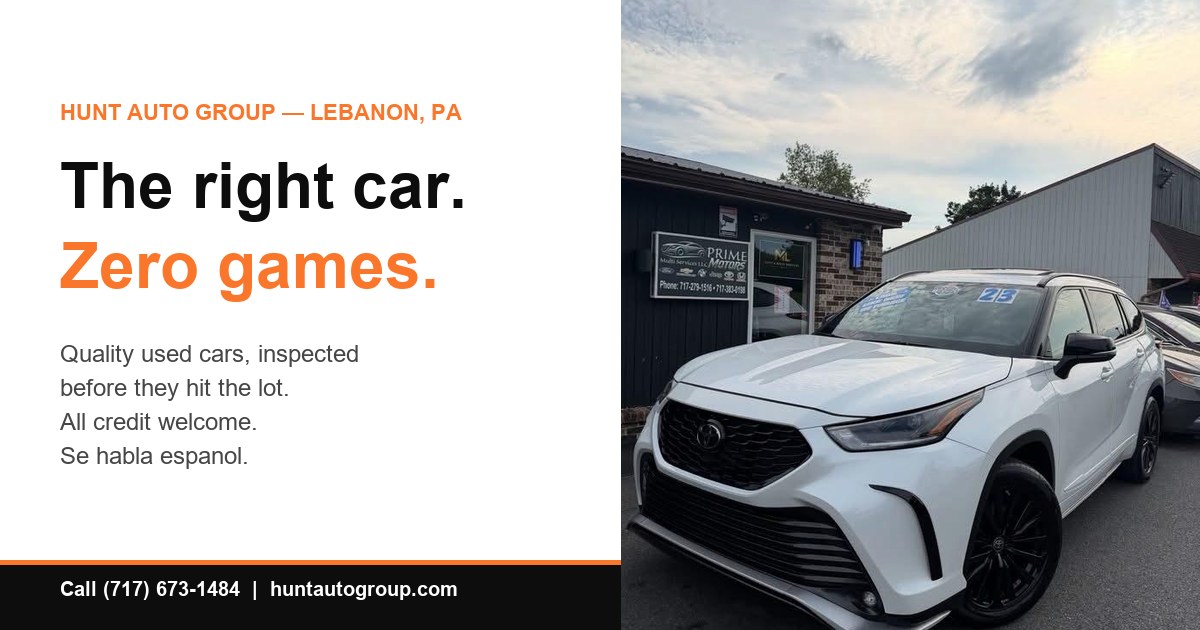
We currently have a 2023 Highlander XSE on our Lebanon lot. See the full listing, read our detailed 2023 Highlander XSE review, apply for financing, or call (717) 673-1484 to test drive. Serving Lebanon, Palmyra, Hershey, and central PA families.